Pre-order · 33% offEnds when Book 1 ships in July 2026

Ship your SaaS in days. Survive production for years.

From your first AI prompt to your first paying customer, without becoming the next "vibe-coded app leaks user data" headline.

Three books, one production repo you actually deploy. Book 1 takes a prototype to a live SaaS charging real cards on a €14 Hetzner box, in two weekends. Book 2 builds an AI content engine that ranks in 14 locales without you babysitting it. Book 3 is the hardening that turns a launched app into a business you can sell: fraud defence, AI features that resist jailbreaks, security a B2B buyer will sign off on. Written by a senior engineer who runs the exact system you're about to build.

Read Chapter 2 free - no email
  • 30-day refund
  • Lifetime updates
  • PDF + EPUB + chapter-tagged repo

Book 1 ships July 2026 · Book 2 September · Book 3 November

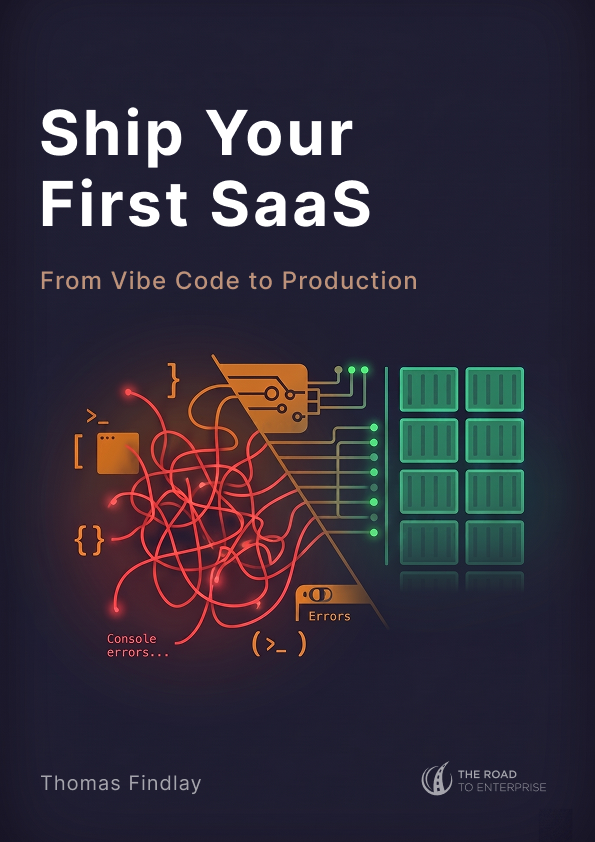
Cover of "Ship Your First SaaS", Book 1 of the From Vibe Code to Production series by Thomas Findlay
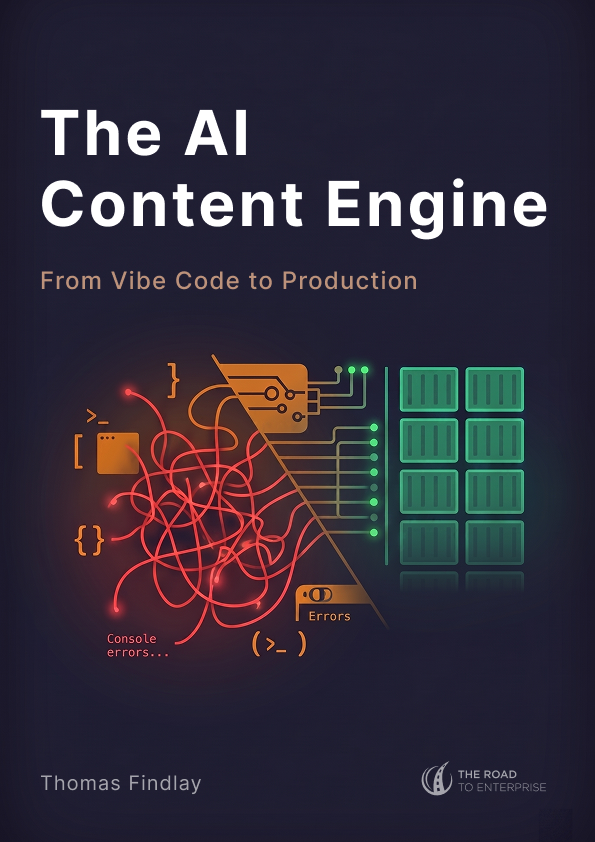
Cover of "The AI Content Engine", Book 2 of the From Vibe Code to Production series by Thomas Findlay
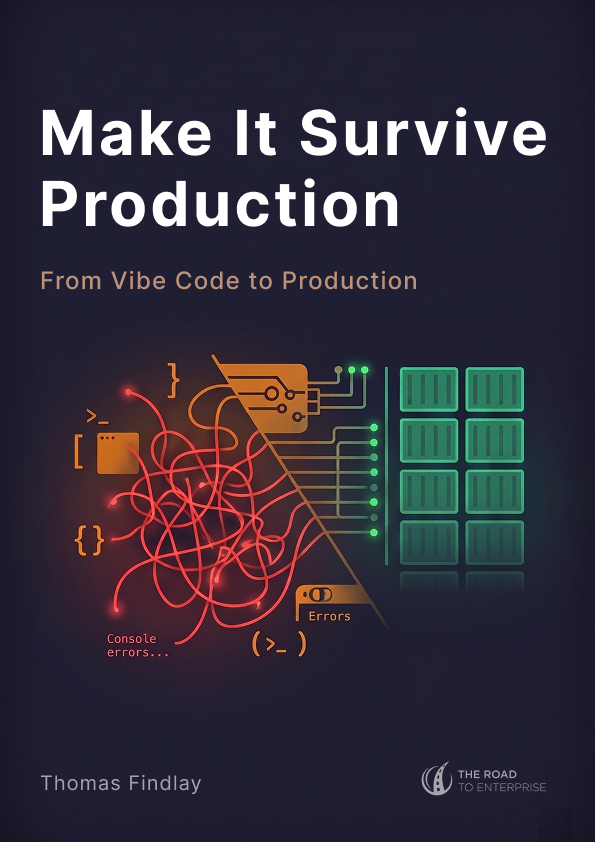
Cover of "Make It Survive Production", Book 3 of the From Vibe Code to Production series by Thomas Findlay
Three books. One project. Hover a cover.

The arc

Three books, in order.

Each book ends with something deployed. The next book picks up the same repo, hardens it, and adds the next layer. No throwaway prototypes between chapters.

  1. 01Ship Your First SaaS

    In two weekends you deploy a real SaaS on a €14 Hetzner box. By the last page it's charging cards, sending real email, isolating tenants in Postgres, and ready for your first paying customer, without a Vercel bill in sight.

  2. 02The AI Content Engine

    While you sleep, your blog ships SEO-ranked articles in 14 locales, humanised, brand-safe, cost-tracked, fully autonomous. A production-tested pipeline shipping hundreds of monthly articles, running on the same €14 box you started with in Book 1.

  3. 03Make It Survive Production

    Your SaaS now survives what kills most prototypes: card-testing fraud, prompt-injection attacks, real-traffic spikes, security reviews from B2B buyers, and the kind of incident postmortem you'd want to publish. Still under ~$30/month. Still on infrastructure you own.

What you'll have shipped

Three concrete outcomes. One repo. Your name on it.

One project, three milestones. Each book ends with something real deployed: not a tutorial sandbox, not a localhost demo.

Book 01

ContentForge, live and charging cards

  • A multi-tenant SaaS deployed on a €14 Hetzner box, not Vercel
  • Stripe checkout, dunning, tax, and the webhook path that survives audits
  • Real email via SES, real auth with Postgres RLS, ready for your first paying customer
Book 02

An AI content engine shipping in 14 locales

  • One command, 14 locales, articles shipping unattended
  • Humaniser, brand guardrails, real per-article token cost numbers
  • A fully autonomous pipeline running on the same €14 box you started with
Book 03

A hardened SaaS that survives real users

  • Card-testing fraud defence so you do not lose your Stripe account in week one
  • Prompt-injection defences and OWASP LLM Top 10 applied to AI features
  • Monthly restore drills, B2B-ready security paperwork, incident postmortems

Why I'm writing this

The playbook came out of the gap AI tooling leaves behind.

I've spent the last two years pairing with AI coding agents on every production system I ship, multi-tenant SaaS apps, billing pipelines, RAG features, multi-locale content engines. AI-assisted dev cut feature delivery time by more than half while I was running engineering teams. It also crashed prototypes that had no business reaching a real user.

This series is the playbook that came out of that gap. Every chapter is a decision I made in production, Postgres RLS patterns, idempotent Stripe webhooks, restore drills, prompt-injection defences, content pipelines that do not read like ChatGPT. The kind of work an AI session will not volunteer until you have already shipped the bug.

If you have been building with AI coding agents and you want to leave prototype-land, without becoming the next "vibe-coded app leaks user data" headline, this is the path.

Portrait of Thomas Findlay

Thomas Findlay

CTO · 13+ years in production · 2,500+ five-star Codementor sessions · React Summit, React Advanced London, Vue Amsterdam speaker · Author of React and Vue The Road To Enterprise.

Where it goes against the grain

Most AI coding books teach Vercel. This one teaches ownership.

Same problems, different defaults. The table is the short version.

TopicWhat most tutorials / boilerplates stop atWhat's in this series
Promise"Ship in days" (then you're on your own)"Ship in days. Survive for years."
FormatShipFast-style $299 boilerplate, code you don't have to read3 books that teach the why plus a chapter-tagged repo you understand line by line
HostingVercelHetzner + Coolify (own your infra)
Cost at 1k users$216+, unpredictableunder ~$30, predictable
Getting paidBasic Stripe checkoutStripe + dunning + tax + dispute evidence
Getting users"Post on Twitter"Product Hunt playbook + B2B sales scripts + integration marketing (Book 3)
Surviving an attackNot addressedCard-testing defence, OWASP LLM Top 10, monthly restore drills
AI features"Call OpenAI"RAG + MCP server + injection defense
Content engine"Write a blog post with ChatGPT"14-locale pipeline, brand guardrails, real cost-per-article numbers
vs. asking an AI agent directlyReinvents the wheel each prompt; no architecture memory97 chapters of decisions your AI agent would never volunteer; a repo as the missing memory across sessions

Want pure framework architecture instead? React - The Road to Enterprise and Vue - The Road to Enterprise cover that ground.

The 2026 objection

Why pay for this when an AI agent can teach me?

Your AI agent can write you a Stripe webhook handler. It can't tell you which idempotency token scheme survived an actual audit. It can't tell you which Postgres RLS pattern stops a tenant-isolation bug a customer's red team will find. It can't volunteer the chapter-tagged repo that makes every architectural decision auditable a year from now.

The 1M-context limit is real. The books are the part your AI session can't remember. The repo is the part your AI agent doesn't ship with your prompts. The 97 chapters are the decisions you'd otherwise hit by accident, once each, the hard way.

What's in each book

Three books. One project. Each picks up where the last leaves off.

The parts list per book. Scroll for the full chapter breakdown below.

Book 01

Ship Your First SaaS

From Vibe Code to Paying Customers

  • The trap (why prototypes die)
  • Foundation (Claude Code, plans, secrets)
  • Own your infrastructure (Hetzner + Coolify)
  • SaaS skeleton (auth, RLS, schema, uploads)
  • Money (Stripe, dunning, tax, support)
  • Email (SES, React Email, bounces)
  • Background work (BullMQ on your own box)
  • Ship it (health checks, status page, launch)

400 pages · 40 chapters

See full Book 1 details ↓
Book 02

The AI Content Engine

Multi-Locale Blog Pipeline that Actually Ranks

  • Why blog still matters (SEO vs LLM SEO vs GEO)
  • Content stack (Fumadocs, MDX, frontmatter)
  • The pipeline (8 stages, 2 human gates)
  • Quality at scale (humaniser, guardrails)
  • Images (Gemini, FAL, R2)
  • Global reach (14 locales, verification)
  • Deployment + maintenance (cost per article)

300 pages · 25 chapters

See full Book 2 details ↓
Book 03

Make It Survive Production

Hardening, AI Features, and Getting Real Users

  • AI inside the product (RAG, MCP, injection defense)
  • Don't lose data (PITR, restore drills)
  • Survive real traffic (WAF, bots, autoscale)
  • Scale beyond one box (read replicas, LB)
  • Quality at AI speed (Playwright, axe, PostHog)
  • Sell to businesses (DPA, CAIQ, Vanta path)
  • Get users (Product Hunt, marketplaces, integrations)
  • Run it like an engineer (incidents, postmortems)

420 pages · 32 chapters

See full Book 3 details ↓

At a glance

Series at a glance.

Format
3 books · PDF + EPUB + GitHub repos · lifetime updates
For
Self-taught and AI-assisted developers who want to ship a real SaaS, not another prototype
Tech
AI coding agents · Hetzner + Coolify · Postgres RLS · Stripe · SES · BullMQ · RAG + MCP · Fumadocs
Price
$100 bundle pre-order $149 launch · $55 to $39 per book
Author
Thomas Findlay · CTO · 13+ years in production · React Summit / Vue Amsterdam speaker · 2,500+ five-star Codementor sessions

Bundle

Get the whole journey.

Three books and their working repos, in one purchase. Buying them later one at a time costs more, breaks the reading flow, and leaves you patching the seams yourself.

Ship in days. Survive for years. Three books and one chapter-tagged repo, written by a senior engineer with 13+ years of production rigour, for the people now shipping with AI coding agents who want their prototype to make it to a paying customer and survive what comes next.

30-day refund. Email support@theroadtoenterprise.com within thirty days of purchase. Lifetime updates included: new chapters and new books appear in your library automatically.

Or buy a single book.

Every book is sold on its own and ships with its chapter-tagged repo. Solo sum $141 versus $100 for the bundle, so the bundle is the better deal once you want more than one.

The "why not Vercel?" question

Why Hetzner and Coolify instead of Vercel?

A €14-a-month Hetzner box runs ContentForge in production through Coolify: Postgres, Redis, BullMQ workers, the Next app, the admin app, and the AI content pipeline all on one machine you own. At a thousand active users that machine is still under 40% CPU. The equivalent on Vercel + Neon + Upstash + Inngest moves past two hundred dollars a month with the same workload and is unpredictable from week to week because every dependency bills per-request.

Vercel is a great fit when you want zero-ops and your traffic is spiky and your margins absorb the bill. The series teaches the other path: you own the box, you own the database, you own the backup strategy, and you pay a flat monthly fee. The trade-off is real: you learn Linux fundamentals, you handle restore drills yourself, you respond to your own outages. The series is written so that trade-off is paid down over Book 1, not avoided.

If the math matters for you, Book 1 walks through it with real numbers from a real ContentForge deployment, not a hand-waved comparison. If the math doesn't matter for you yet but you want to stop watching your serverless bill, this is the same answer from a different angle.

The honest answer

Can a vibe coder really ship a production SaaS?

Yes if you can read JavaScript, clone a repo, and run npm install. No if you want managed-everything and do not want to learn ops. The series does not pretend that an AI coding agent can deploy your SaaS for you. It treats AI tooling as what it is: an accelerant for someone who is doing the work of becoming a real engineer.

Book 1 is paced so a self-taught developer or a senior engineer new to web ops can follow it end to end and ship ContentForge. You will write code with your AI coding agent, read the diffs like a code reviewer, and learn the production scaffolding that AI tools skip by default: Postgres Row-Level Security, Stripe webhook idempotency, SES bounce handling, BullMQ at-least-once semantics, deployment hygiene, observability, backups.

The point is not to make you stop using AI to generate code. It is to make sure the code you ship survives the first real user, the first real charge, and the first real attacker. By the end of Book 3 you have a SaaS that can take card-testing fraud, prompt injection attempts, restore drills, and B2B sales conversations without falling over.

Ship in days. Survive for years. The full journey, in one repo. One real ContentForge project. One €14 Hetzner box. Three books. AI-built prototype on Monday, charging cards by month-end, surviving fraud and prompt-injection by month three, ranking in 14 locales by the time you forget the URL of your old Vercel dashboard.

Book 01

From Vibe Code to Paying Customers

Ship Your First SaaS

In two weekends you deploy a real SaaS on a €14 Hetzner box. By the last page it's charging cards, sending real email, isolating tenants in Postgres, and ready for your first paying customer, without a Vercel bill in sight.

Cover of "Ship Your First SaaS", Book 1 of the From Vibe Code to Production series by Thomas Findlay

By the end of this book, you'll have shipped

  • Multi-tenant isolation that survives a security review
  • 1,000 users for under ~$30/month: the math behind the box
  • The Stripe webhook path that survives audits

Inside this book

  1. 01The trap (why prototypes die)
  2. 02Foundation (Claude Code, plans, secrets)
  3. 03Own your infrastructure (Hetzner + Coolify)
  4. 04SaaS skeleton (auth, RLS, schema, uploads)
  5. 05Money (Stripe, dunning, tax, support)
  6. 06Email (SES, React Email, bounces)
  7. 07Background work (BullMQ on your own box)
  8. 08Ship it (health checks, status page, launch)

400 pages · 40 chapters

Signature chapters

  • Multi-tenant isolation that survives a security review

    Raw CREATE POLICY + set_config() transactions. The book's signature differentiator. No canonical reference exists.

  • 1,000 users for under ~$30/month: the math behind the box

    Cost math, predictability, ownership. The chapter every other AI coding book skips.

  • The Stripe webhook path that survives audits

    Idempotency, replay, signing. The Stripe path that survives audits.

Or get all three for $100 →

30-day refund · lifetime updates

Book 02

Multi-Locale Blog Pipeline that Actually Ranks

The AI Content Engine

While you sleep, your blog ships SEO-ranked articles in 14 locales, humanised, brand-safe, cost-tracked, fully autonomous. A production-tested pipeline shipping hundreds of monthly articles, running on the same €14 box you started with in Book 1.

Cover of "The AI Content Engine", Book 2 of the From Vibe Code to Production series by Thomas Findlay

By the end of this book, you'll have shipped

  • Articles that don't read like ChatGPT
  • One command, 14 locales, articles shipping unattended
  • Token cost per article: real numbers from real production runs

Inside this book

  1. 01Why blog still matters (SEO vs LLM SEO vs GEO)
  2. 02Content stack (Fumadocs, MDX, frontmatter)
  3. 03The pipeline (8 stages, 2 human gates)
  4. 04Quality at scale (humaniser, guardrails)
  5. 05Images (Gemini, FAL, R2)
  6. 06Global reach (14 locales, verification)
  7. 07Deployment + maintenance (cost per article)

300 pages · 25 chapters

Signature chapters

  • Articles that don't read like ChatGPT

    The humaniser pass. Em dashes, robotic intros, generic transitions, all gone.

  • One command, 14 locales, articles shipping unattended

    One command. 14 locales. Auto-fix, build-check, undraft. Real production pipeline.

  • Token cost per article: real numbers from real production runs

    Real token numbers from production runs. Budgets, kill switches, observability.

Or get all three for $100 →

30-day refund · lifetime updates

Book 03

Hardening, AI Features, and Getting Real Users

Make It Survive Production

Your SaaS now survives what kills most prototypes: card-testing fraud, prompt-injection attacks, real-traffic spikes, security reviews from B2B buyers, and the kind of incident postmortem you'd want to publish. Still under ~$30/month. Still on infrastructure you own.

Cover of "Make It Survive Production", Book 3 of the From Vibe Code to Production series by Thomas Findlay

By the end of this book, you'll have shipped

  • Don't lose your Stripe account in week one
  • User content that can't hijack your AI features
  • Monthly proof your backup actually works

Inside this book

  1. 01AI inside the product (RAG, MCP, injection defense)
  2. 02Don't lose data (PITR, restore drills)
  3. 03Survive real traffic (WAF, bots, autoscale)
  4. 04Scale beyond one box (read replicas, LB)
  5. 05Quality at AI speed (Playwright, axe, PostHog)
  6. 06Sell to businesses (DPA, CAIQ, Vanta path)
  7. 07Get users (Product Hunt, marketplaces, integrations)
  8. 08Run it like an engineer (incidents, postmortems)

420 pages · 32 chapters

Signature chapters

  • Don't lose your Stripe account in week one

    Turnstile, Stripe Radar, IP velocity. The fraud chapter that saves your Stripe account.

  • User content that can't hijack your AI features

    OWASP LLM Top 10 applied to user-uploaded content. Most AI books skip this entirely.

  • Monthly proof your backup actually works

    Monthly proof your backup actually works. Includes a postmortem template.

Or get all three for $100 →

30-day refund · lifetime updates

Engineering rigour, by track record

Reviews of Thomas's previous engineering books.

The same rigour applied to the new series. Senior engineers and framework maintainers on the React and Vue Road to Enterprise books, an honest proxy for the bar this series is being written to.

Most tutorials and books teach you fundamentals of React but they don't help much when it comes to best practices or how your code should scale to production levels. Not only will you learn how to code but you will see real applications, testing using modern industry techniques and a very in depth step by step guide showing you how to do everything. If your goal is to stand out in the Marketplace as a React developer, this is the book you should be reading to make that happen. 10/10 definitely recommend.
Danny Thompson portrait
Danny ThompsonSenior Developer Advocate at Atlassian
"React - The Road to Enterprise" is a solid overview of useful patterns and key concepts for developing real-world React applications. Rather than yet another React intro tutorial, it covers practical techniques for topics like project structure, async requests using a home-grown and with React Query [now TanStack Query], state management with Redux and Zustand, routing, bundle management, security, and testing. It's an excellent resource for anyone who is comfortable with the basics of React and is ready to put those into practice in building meaningful applications.
Mark Erikson portrait
Mark EriksonRedux Maintainer & Software Developer at Replay.io
Thomas Findlay has completely changed my mindset on how to structure existing or new projects. While watching YouTube, or some other tutorials doesn't teach you how to scale a project correctly. They teach you only fundamentals! His book is geared to you, only, and knows how to build things in Vue. If you are feeling unsure if you are scaling and structuring your projects correctly, then I highly recommend giving Vue - The Road to Enterprise a chance!
Khoi Hoang

FAQ

Pre-order, bundle versus solo, refunds, and what's inside.

Why pay for this when an AI agent can teach me?
Your AI agent can write you a Stripe webhook handler. It can't tell you which idempotency token scheme survived an actual audit. It can't tell you which Postgres RLS pattern stops the tenant-isolation bug a customer's red team will find. And every AI session starts from scratch, there's no chapter-tagged repo, no memory of the decisions you made last week, no warning about the foot-gun three commits ahead. The series is 97 chapters of decisions you'd otherwise hit by accident, plus a repo that is the memory your AI session can't keep.
Can I see a chapter first?
Yes, two of them. Read Chapter 2, "Real Disasters That Shipped This Year", right now in your browser, no email required. Want more depth? Drop your email and we'll send you Chapter 5, "Your Operational Stack", the full toolchain chapter, as a PDF. Read Chapter 2 free →
Is this series for me?
If you're shipping things with an AI coding agent, or you want to start, this series is written for you. The book walks every step from a prompt to a deployed SaaS to a hardened production system to an AI content engine. You don't need a CS degree, a senior title, or even prior JavaScript experience, you'll be reading and modifying real production code with your AI tools alongside you. The faster path is to be comfortable reading JavaScript or TypeScript and able to run npm install, that lets you follow without context-switching. But the books are paced so a self-taught developer or a non-coder learning with AI can follow along, one chapter at a time. Pick what you need.
Will Books 2 and 3 actually ship on time?
Book 1 ships July 2026, Book 2 around September, Book 3 around November. If a book slips past its window you'll hear it from me first, and a refund is one email away, no questions asked, no re-buying. Bundle buyers get every new book the day it ships and every update for life.
What does "lifetime updates" actually mean?
Every chapter rewrite, every new chapter, every new edition. You log in to your library and the latest PDF + EPUB are there. No "v2" repurchase. New books in the series? Bundle buyers get those too, day of ship.
Does this cover getting customers?
Partly. Book 3 has a full section on launch tactics (Product Hunt, marketplaces, integration marketing, B2B sales conversations, DPA + CAIQ + Vanta paths). It's not a marketing course, this is a production-engineering trilogy first. But you can't market a SaaS that doesn't survive its first paying customer, which is why we cover shipping and surviving before customer acquisition.
Do I need to know JavaScript, ops, or Linux to start?
The faster path is to be comfortable reading JavaScript or TypeScript and able to run npm install, that lets you follow without context-switching. But you don't need a CS degree or prior backend experience. If you've been shipping anything with an AI coding agent, you're in the right place. Linux and ops are taught from first principles in Book 1, no prior server experience required. You'll learn enough to run a Hetzner box, restore from a backup, and read a logfile by the end of Book 1.
Refund policy?
30 days, no questions asked. Email support@theroadtoenterprise.com and we'll refund you. The point is that you ship things, not that I keep your money.
Bundle vs solo: which is the better deal?
Solo prices are $59 / $49 / $69 at launch ($177 total). The bundle is $149 launch, so you save $28 vs buying all three solo. During pre-order solo prices are $47 / $39 / $55 ($141 total) and the bundle is $99, so you save $42 vs the solo sum and $50 vs the $149 launch bundle price. The bundle is the cheaper move the moment you want more than one book, and the pre-order window is the cheapest moment to commit.
What is the difference between this series and free tutorials on YouTube (or free AI chat sessions)?
Tutorials almost always stop at "it works on localhost." Free AI chat sessions restart from scratch every time and reinvent the wheel on each prompt. This series picks up where both of those stop. Book 1 takes one project (ContentForge) from an AI-built prototype to a deployed multi-tenant SaaS on Hetzner with Stripe, SES, Postgres RLS, and BullMQ. Book 2 layers an AI content engine on top of it. Book 3 hardens the same project against real traffic, fraud, AI prompt injection, and incident response. Every chapter ships with a git tag on the same repo, so you can branch from any point. No tutorial chain that you have to stitch together yourself, and no AI session amnesia between decisions.
How is this series different from the React and Vue "The Road To Enterprise" books?
Different audience and different product. The Road To Enterprise books teach React or Vue architecture for engineers already shipping in those frameworks. From Vibe Code to Production walks one ContentForge project from an AI-built prototype through to a deployed SaaS, then to production hardening and AI features, then to a multi-locale content engine. Frameworks are a means to an end, not the subject. If you want to learn enterprise React or Vue, buy the framework books. If you want to ship and survive a SaaS, buy this series.
What is vibe coding?
Vibe coding is the term used for building software by prompting AI coding agents (Cursor, Claude Code, OpenAI Codex, v0, GitHub Copilot, ChatGPT, and the rest) instead of writing every line yourself. It is fast for prototypes and demos. It tends to fall over the moment a real user, a real payment, or a real attacker shows up, because the prompts produce code that works in isolation but is missing the production scaffolding around it: deployment, persistence, auth, billing, observability, security, scale. This series is written for people who have been vibe-coding and want to ship something that survives that next step.
I already own Book 1 or Book 2. Can I upgrade to the bundle?
Email support@theroadtoenterprise.com with your original receipt and we will sort it out. You only pay the difference between what you've already spent and the current bundle price, no re-buying chapters you already own.

Read Chapter 5 of Book 1 free

It's the full operational stack chapter: Claude Code, token instrumentation, semantic code search, and the project memory that keeps an AI agent on the rails. Drop your email and it's in your inbox in the next minute, plus a heads-up the day Book 1 ships.

Pre-order today. Ship in 2026. Survive production for years.

Three books and three repos. One project. One Hetzner box. Lifetime updates. 30-day refund.