

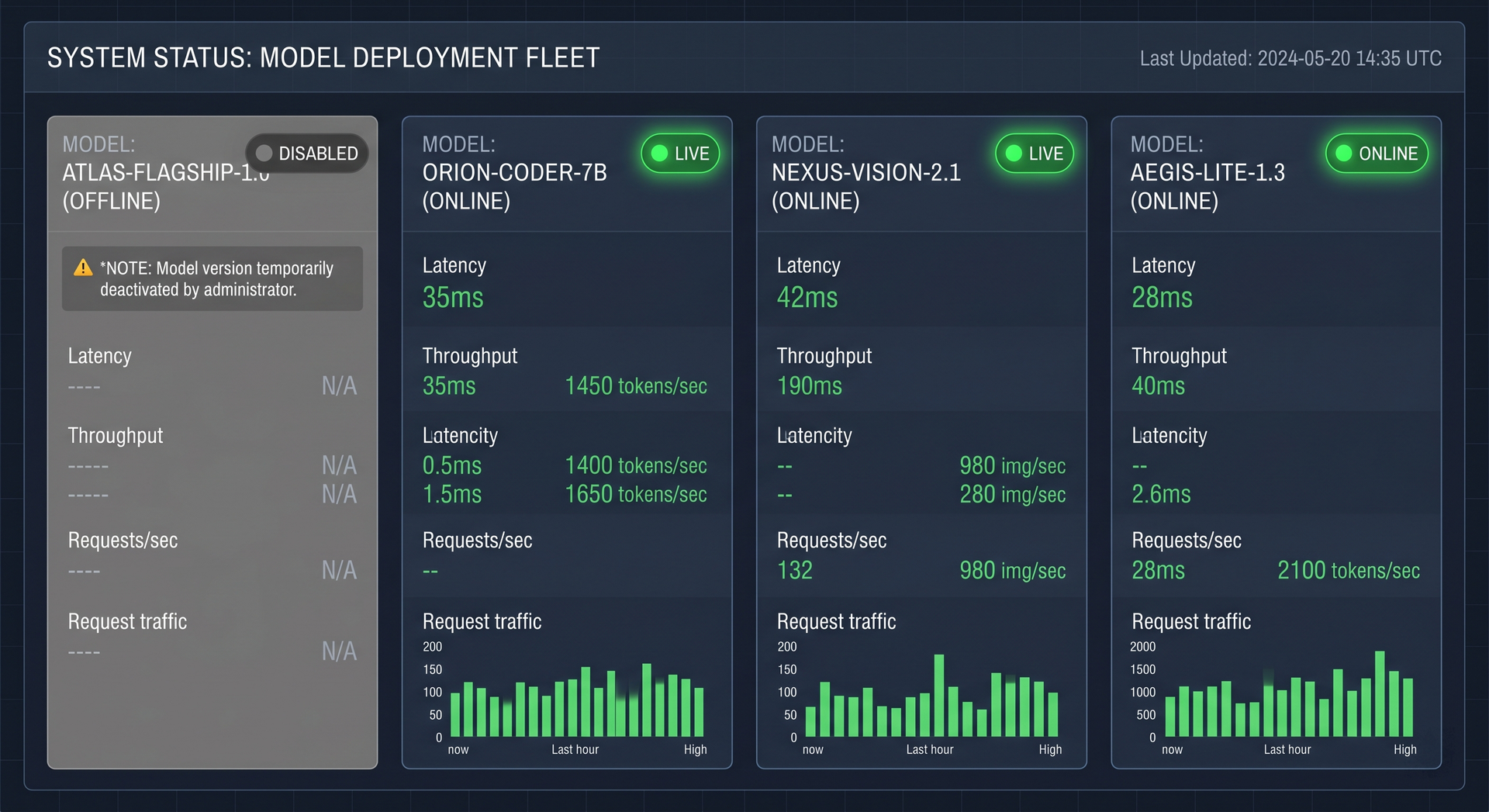
A model your product depends on can be cut off with no notice, and on 12 June 2026 that stopped being hypothetical. The Fable 5 and Mythos 5 shutdown took both models offline within hours of a government directive, and any app that named one of them in code started returning errors. Your fix is the one you apply to any unreliable dependency: treat the model ID as replaceable configuration behind one boundary, not a welded-in constant.
This is an engineering lesson for teams building on frontier model APIs, written the day after the 12 June 2026 shutdown. It is not a politics piece.
TL;DR: this is a dependency problem, not a politics problem
The Fable 5 and Mythos 5 shutdown reads like a regulatory story, and the cause was regulatory. Your codebase damage was not. Apps with a hardcoded model ID needed a code change, a CI run, and a deploy to recover, while apps that read the ID from configuration changed one value and pointed the same call at a model that stayed up. Model availability is a production dependency you do not control, so architect for its loss the way you do for a payment API that can return a 503.
What happened on 12 June 2026
Anthropic received a US government export-control directive at 5:21pm ET. The order, citing national security, required Anthropic to suspend all access to Fable 5 and Mythos 5 for "any foreign national, whether inside or outside the United States," a group that includes foreign nationals working inside the US and Anthropic's own non-citizen employees. With no feasible way to enforce that per user at speed, Anthropic disabled both models for every customer.
The company called the trigger a narrow, non-universal jailbreak "which essentially consists of asking the model to read a specific codebase," and disagreed that such a finding should be cause for recalling a commercial model. It said it believes the directive is a misunderstanding and is working to restore access as soon as possible, and warned that if the same standard were applied across the industry, it "would essentially halt all new model deployments for all frontier model providers." You can read Anthropic's full statement.
One detail decides whether this was an incident or a catastrophe: "Access to all other Anthropic models will not be affected." Two models went dark; the rest of the catalog kept serving.
What actually broke in production code
The fastest way to ship an AI feature is to call the SDK in the handler that needs it, with the model ID sitting right there in the call. It works on the first try, and it is the shape an AI assistant generates when you ask it to summarize a ticket with Claude. That same shape broke on 12 June: a handler that said model: 'claude-fable-5' returned a 404 the moment the model was disabled, and kept throwing on every request until a human shipped a change.
What made the outage expensive was coupling, not the model choice. The model ID was fused to the business logic of the feature, so changing it meant editing, reviewing, and redeploying that file. Response parsing was welded in too: reading response.content[0].text assumes the Anthropic message shape. A hardcoded integration couples three things that should move independently, which model runs, which client makes the call, and how the app reads the result. None of those functions degraded when Fable 5 went away. They failed hard, and stayed failed until someone intervened. A hardcoded model ID is a single point of failure.
Which models stayed available during the shutdown, and why a same-vendor swap was the fast fix
Because every other Anthropic model stayed live, the fastest mitigation on shutdown day was to swap to another Claude model rather than to another provider. The still-available targets were claude-opus-4-8, claude-sonnet-4-6, and claude-haiku-4-5-20251001, and a team pointing its calls at any of those was back in minutes.
A same-vendor swap is cheap because it changes nothing except a string. The SDK call shape and the response shape are identical across these models, so the messages.create call and the content[0].text parsing keep working untouched. Point the same code at a different provider such as GPT-5.5 or Gemini 3.1 Pro, though, and the wire format changes, so you need an adapter or a gateway to normalize it. Within one provider, failover is free; across providers, it is a project. On an outage clock, free wins, which is why a tested same-vendor fallback chain is the one thing worth having ready in advance.
The assumption every AI app makes
Almost every AI feature carries one unstated assumption: the model you integrated today will be callable tomorrow. It usually holds, which is why it goes unexamined, and the model ID quietly hardens into a constant nobody revisits.
The 12 June shutdown is the counterexample that makes the assumption visible. A model can leave your dependency graph for reasons that have nothing to do with your code: a regulatory order, a deprecation notice, a capacity crunch, a pricing change that makes it uneconomic overnight. You would never hardcode a single payment processor with no failover and assume it can never error. The model API deserves the same treatment.
Three changes to make now
Three concrete changes move you from "throws until a human deploys" to "fails over to a model that works." No platform rebuild needed.
Put the model behind one boundary
Route every model call through a single function, and pass it intent (the prompt, the token budget), never a model ID. Features ask that boundary for a completion and get back a plain string; which model produced it, and through which SDK, is the boundary's concern. Provider-specific knowledge then lives in one place instead of being scattered across handlers. The full TypeScript build, including how to translate provider errors into a "try the next model" signal versus a "stop, the request is broken" signal, is in building a model-agnostic AI layer with typed fallbacks.
Add a fallback target you have actually tested
A boundary with no fallback is only an indirection. Behind it, keep an ordered chain: a primary model and one or more alternates the layer tries when the active model returns an availability error (a 404 from a disabled model, a 429, or a 5xx). On 12 June, a chain of claude-opus-4-8,claude-sonnet-4-6,claude-haiku-4-5-20251001 read from configuration would have ridden out the shutdown with no deploy at all. Order it by cost and quality per use case, since summaries and code generation rarely want the same model. The fallback logic, the error classification it depends on, and the build-it-versus-gateway decision are walked through in the model-agnostic AI layer guide.
Write one eval so a swap is safe
A fallback model you have never tested is a guess you will validate for the first time during an outage, the worst moment to learn that the alternate mangles the JSON your parser expects. Write at least one eval, a fixed input with an asserted property of the output, and run it against every model in the chain, not just the primary. It does not have to be elaborate, but it has to exist before the swap, so failover is a known-good path rather than a leap.
What to watch next after the shutdown
The near-term question is reinstatement. Anthropic said it believes the directive is a misunderstanding and is working to restore access as soon as possible, so Fable 5 and Mythos 5 may return, though no date is confirmed. Anthropic's statement is where any update will land first.
A longer-term signal matters more than this one event. Anthropic warned that the standard behind the directive, if generalized, "would essentially halt all new model deployments," so the precedent reaches every frontier provider, not only one. That is not a reason to panic or abandon a vendor. It is a reason to make sure no single model ID is load-bearing, so the next shock, from any provider, is something you configure around rather than scramble against. The same instinct drives hardening an AI-generated React app for production and vibe coding versus production coding in React, pointed at the runtime dependency instead of the code.
Conclusion
The Fable 5 and Mythos 5 shutdown was a preview of every way a model can leave your dependency graph without warning, and the teams that shrugged it off were not lucky. They had already decided that a model ID is configuration and that every call goes through one boundary that can fail over. If you ship one change from the 12 June outage, make it that boundary, then put your fallback models through the same evals as your primary. The complete implementation is in the model-agnostic AI layer guide. A model will change on someone else's schedule. Your call site should not have to.